There are footballers who make you sit forward in your chair. Beautiful players. Elegant players. Players who appear to have negotiated a private agreement with gravity. Then there was Gerd Müller. You could spend most of a match wondering where he was, only to find him standing beside a goalkeeper who was picking the ball out of the net. Again. The commentator barely needed a vocabulary. Müller. Shot. Goal. Repeat until the opposition requested a different arrangement.
They called him Der Bomber. A nickname earned through the thoroughly unreasonable number of times he put a football where defenders had specifically asked him not to. He could turn in a space most people would struggle to park a shopping trolley. A loose ball, a moment’s hesitation, the faintest suggestion of an opening: Müller had already dealt with it while everyone else was still considering the possibilities.
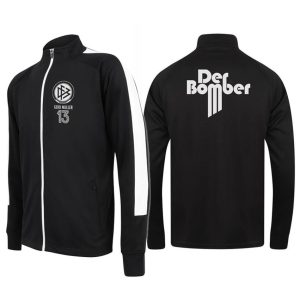
Our Poeha tracksuit celebrates that particular kind of brilliance. Black, white, his name and number on the front, Der Bomber across the back. There is something satisfying about wearing a tribute to a man whose work required so little explanation. He scored. Frequently. Inconveniently, if you happened to support the other side.
And if you are Dutch, yes, we know. We will get to that. Take a breath. Nobody is asking you to watch the replay just yet.
Football has always loved a certain image of the athlete: tall, commanding, preferably photographed looking into the distance with a meaningful expression. Müller offered a rather different proposition. Compact, sturdy and balanced, he looked built for the crowded, awkward business that happens close to goal. While others enjoyed the view from midfield, he worked where elbows, boots and desperate decisions came together.
His skill could be easy to underestimate because the final action sometimes looked so simple. A touch. A turn. A finish. But simplicity at that level is expensive. It takes anticipation, timing and the ability to stay upright when several people have an interest in the opposite outcome. Müller seemed to know where a ball would arrive before the ball had received the information itself.
There was little point in admiring him from a safe distance. By the time a defender decided to get closer, the damage was usually done. He made a career out of the spaces other players barely noticed, scoring the sort of goals people sometimes dismiss as easy. Funny how the same man kept being available to score them.
He was central to Bayern Munich’s rise and a decisive figure for West Germany. Yet the appeal goes beyond medals. There is pleasure in watching somebody do their job exceptionally well, without turning every moment into an announcement about themselves. Müller let the scoreboard handle his publicity. It was a dependable arrangement, although not especially popular with visiting teams.
Every country has sporting memories it returns to with affection. The Netherlands has 1974, although affection is occasionally interrupted by a sharp pain behind the eyes. Johan Cruyff. Total Football. That orange team. Football played with such confidence and invention that the ending still feels, to many Dutch supporters, like an administrative error awaiting correction.
Unfortunately, Gerd Müller had a different understanding of how the afternoon should conclude.
His winning goal in the World Cup final was recognisably his: control, adjustment, turn, finish. An entire Dutch dream encountered a man who needed very little room to spoil it. There are more elaborate ways to become part of football history. Few are more effective.
Wearing his name in the Netherlands therefore requires a certain generosity of spirit. Or friends who enjoy discussing old grievances over a drink. Possibly both. Someone will mention Cruyff. Someone will explain why the better team did not win. Someone who was barely alive at the time will contribute an unusually detailed opinion. The jacket has already earned its place in the conversation.
At Poeha, we like a design with a story behind it. Ideally, a story that can cause a small disagreement without ruining dinner. Der Bomber qualifies beautifully. You can admire Müller while remaining devoted to Dutch football. Sporting appreciation is large enough to accommodate both. Whether your uncle agrees is another matter entirely.
A football career comes with a timetable. Training. Travel. Matches. Recovery. The same people, the same routines, the next opponent. Even the pressure gives the week a shape. For someone who has lived inside that structure for years, retirement can leave a great deal of empty space.
Supporters remember the goals and assume the person who scored them will carry on being happy about it. A room full of medals should help, surely. So should being recognised in restaurants. But admiration does not organise your Tuesday morning. Old match footage cannot replace the feeling that somebody expects you at training.
After his playing career, Müller struggled badly and developed alcohol addiction. That is part of his story, and it deserves to be told without making him the punchline. The jokes belong to defenders chasing shadows and Dutch supporters reopening old wounds. They do not belong to a man having difficulty finding his way through life.
His experience exposes something football can be remarkably poor at explaining. A player may spend years being indispensable, then discover that the world can arrange the next season perfectly well without him. The crowd moves on. New names appear. Somebody else takes the shirt.
For Müller, the transition was painful. The instinct that had served him so brilliantly in front of goal offered no simple answer outside the game. And the people who knew him had to recognise that remembering his achievements was no substitute for helping the person standing in front of them.
This is where the story becomes bigger than a famous striker. Müller’s former Bayern companions, particularly Uli Hoeneß, helped him seek treatment. Afterwards, the club brought him back into its working life as a coach, including with its youth and reserve players.
It would be easy to describe that as giving an old hero something to do. But that understates both the value of the work and the importance of belonging. Müller had knowledge that younger players could use. He understood movement, finishing and the strange little decisions that separate an almost-goal from an actual one. You would imagine a young striker might occasionally pay attention when that man offered advice.
The role also gave him routine, company and a reason to turn up. He could contribute again. People expected him. There was a place for him inside the club whose history he had helped create.
Football uses the word family generously. Usually somewhere near a camera, a sponsor board or a season-ticket renewal. Here was a practical expression of it. Former teammates recognised that somebody needed support and stayed involved beyond the moment when offering support looked good.
They could not complete his recovery for him. That required his own effort, alongside treatment and the people around him. But they helped make a route back possible. For a man who had so often been in the right place for his teammates, it mattered that they found a way to be there for him.
That is why this Poeha tracksuit carries more than a football nickname. On the front, Gerd Müller and the number 13. On the back, Der Bomber. At first glance, it is a tribute to a legendary goalscorer. Stay with the story a little longer and it becomes a reminder of the people who stood beside him when his name was no longer appearing on the scoresheet.
There is a pleasing fit between that history and a tracksuit. This is clothing that belongs near a pitch, on the way to training, or beside somebody explaining what the striker should have done. It also works perfectly well for walking to the bakery. Nobody is checking your international appearances before selling you bread.
Wear it because you remember Müller playing. Wear it because you discovered him through old footage. Wear it because football history contains characters worth knowing beyond the latest transfer announcement. You may even wear it as a Dutch supporter, although a brief explanation at family gatherings might be necessary.
We chose a design that lets the name do the talking. Müller had already supplied the material: the goals, the impossible turns, the defeated goalkeepers and that afternoon in Munich. His friends supplied another chapter, one that makes the tribute warmer and more human.
So yes, celebrate Der Bomber. Celebrate the man who could turn almost nothing into a goal. Then remember the teammates who helped him find a place in the game again.
Müller schießt. Tor! Was sonst?